Lessons from Umpire Bucknor
Fri, Sep 30, '05
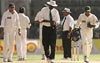
Steve Bucknor to me: What are you working on today?
Me: Going to do an interview after the game.
Bucknor: So, you're not writing about the match?
Me: Not at all. I don't know much about the technical aspects of cricket. I will get the positions wrong.
Bucknor: It's easy to learn man. You going to be here tomorrow?
Me: Yes.
Bucknor: Come with your paper tomorrow and I will show you.
That sounded more like an instruction rather than a kind offer to help a cricket novice learn the game, but once you find out that the gentleman used to be a Math teacher, then you will understand the tone.
After watching cricket for 20 years, I've decided that it's about time that my knowledge of the rudiments of the game moves from spotty to passable. The lack of knowledge was most recently verified during the last regional tournament when I said Chris Gayle caught the ball at slip to win the match against Barbados. He had in fact moved to mid wicket and I did not know this position!
The tournament is coming up soon and, being very much into self-development, I decided that this was going to be the year for lessons in cricket. Can't let World Cup 2007 catch me in the same state of unknowing. What better person from whom to get my first lessons than the esteemed West Indian ICC elite panel umpire Steve Bucknor.

David Ausubel, a distinguished educational psychologist said, "the most important single factor influencing learning is what the learner already knows. Ascertain this and teach him accordingly." It was against this background that I eagerly wanted to show Mr Bucknor what I knew.
He protested, but I insisted. With my paper and my pencil I drew what I knew. The slips, gully, fine leg, third man, point...that was it. The gentle Bucknor looked at it, didn't comment, then asked me for another sheet of paper and my pencil. Then he started to draw.
First the pitch. Then the symbol to represent the right handed batsman which he labelled RHB. Then, the wicketkeeper. Slowly and methodically, he went through all the areas on the field. And then I saw how much I really did not know. No kidding.
What did I learn? How a position comes to start with 'forward' or 'backward', what differentiates 'short' from 'silly', the positions 'mid on', 'mid off', 'cover point', 'mid wicket', the terms 'straight' and 'fine', among other things. The theory part of the lesson over, it was now time for practical application, a necessary part in any lesson to establish if you have really learnt.
Teacher Bucknor pointed to a man and asked "that man there, what position is he in?" I wanted to be the good student who didn't need to look on my notes, so I tried to work it out in my head...slowly. Wrong. I was encouraged to look on my notes after the first couple of answers weren't exactly right. This I did and the response became more correct. To be fair to me, the position we were watching the game from made it difficult for me to gauge the positions. Not for umpire Bucknor. Of course, with over 100 Tests and many regional matches under his belt, he could probably tell them with his eyes closed!
Me now with my glasses, will still have to stop and think is this a right handed or left handed batsman? Is this the off or on side? Is it in line with the crease or not? In the 'V'? Fine or straight? Short or silly? It's a lot to think about. Bucknor agrees.
That day, I came to the conclusion that a Bucknor at hand was worth more than two (there are no bushes) internet-collected pictures of field placings. Dem fi dash weh. Only afterwards when we were done did I understand why he was protesting when I was insisting.
So good and gentle people, such that Mr Bucknor is, next time when you see me dutifully and studiously poring over some yellow and while sheets of paper while at a cricket match, yes, it's homework that I'm doing.
I'm truly a student of the game and this lesson was short and to the point with everything covered.
