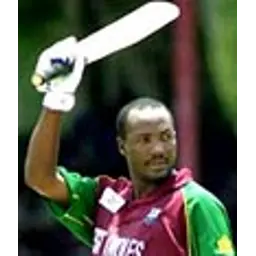
Brian Lara: Batting Genius
By KWAME LAURENCE - (Trinidad Express)April 18 is no ordinary date. On April 18, 1955, the world lost
a genius. Albert Einstein, arguably the most famous scientist of
all time, passed away. Exactly 39 years later, a genius of another
kind was celebrated.
An epic knock of 277, against Australia in January 1993, had
announced the arrival of a unique cricketer. Surely, this young man
from the Santa Cruz valley in north Trinidad was on the road to
greatness. There seemed little doubt he had the stuff champion
batsmen are made of.
On April 18, 1994, Brian Charles Lara added an exclamation mark
to his emphatic batting statement Down Under, answering
conclusively any questions about his pedigree.
Sir Garfield Sobers was on hand, at the Antigua Recreation Ground
(ARG), to see his 36-year-old Test batting record fall, at the
hands of cricket?s latest genius.
In 1958, at Sabina Park, Jamaica, the great Barbadian allrounder
had piled up a massive score of 365, against Pakistan.
But records are made to be broken. England pacer Andy Caddick
unwillingly got into the record books when Lara drove him to the
extra-cover boundary to draw level with Sobers.
In an interview with Red Stripe Quarterly (RSQ), after his world
record knock, Lara looked back fondly on that moment.
?To be able just to share the record with Sir Garry was
overwhelming. He is such a great man. I never saw him play
international cricket but what I?ve heard from everyone, he had to
be a great cricketer.?
The young and inexperienced, yet assured, Shivnarine Chanderpaul
was not going to keep back history. The Guyanese batsman took a
single off the second ball of the next over, bringing Lara into
strike to face Chris Lewis. The England quickie bustled in and
pounded the ball into a pitch that had offered no encouragement to
the bowlers.
A short ball was the perfect offering for Lara. He pulled the
sphere to the boundary to reach 369, claiming sole ownership of the
world record.
?He (Lewis) was quite expensive over the first two days but he did
bowl a much tighter line that day and made things pretty hard for
me. But the minute I saw him running in to bowl that ball, the
energy I saw him putting in, I kind of predicted it was going to be
short. I latched onto it pretty early and got it away.?
The scenes that followed were tremendous. Uninhibited, spontaneous
celebration swallowed Lara. He had been a colossus at the crease,
but disappeared when the forest of ARG spectators migrated from the
stands to the field.
It took a while, but finally, King Sobers got to his heir. With a
warm, genuine hug, the mantle had been passed to the Prince of Port
of Spain.
"Just to be on par with him, statistics-wise, was great," Lara told
RSQ. "Yes, to get there with a four and then to pass it with
another four erased the pressure."
Nothing, after 369, mattered. Exactly what Lara?s final score would
be was of little interest. The record had been broken. Cricket
fans, and non-fans alike, throughout the region erupted into wild
celebration.
Personally, I saw the fateful pull on a television screen, at
Trinidad Broadcasting Company (TBC) on Maraval Road. That was all I
saw, until the recorded highlights were aired later in the day.
Bodies and voices, screaming at maximum volume, had suddenly
separated me from the television?s screen and speakers.
A tired Lara finally departed, just before lunch on the third day
of that fifth and final Test against England. The Prince, caught by
wicketkeeper Jack Russell off Caddick?s bowling, for 375, had spent
12 hours and 46 minutes at the crease, facing 538 balls. He had
written his name into the history books, making April 18 his date.
April 18 had previously seen many special cricketing events. But
what Lara had done was extra special. That pull to the midwicket
boundary, 19 minutes before lunch, had earned him immortality.
Just eight men, before Lara, had laid claim to the Test batting
record?Australians Charles Bannerman (165 not out), Billy Murdoch
(211) and Donald Bradman (334), England?s Reginald Foster (287),
Andy Sandham (325), Wally Hammond (336 not out) and Len Hutton
(364), and, of course, Sobers (365 not out).
Englishman Doug Insole and West Indians Irving Shillingford,
Malcolm Marshall and Phil Simmons were all born on April 18...in
different decades, of course.
And on April 18, 1971, India?s ?Little Master?, Sunil Gavaskar,
followed up on his first innings knock of 124, against West Indies,
with a second innings 220.
Gavaskar was impressive, and he was a very special talent. But, in
1994, the 25-year-old West Indies star took over as the number one
April 18 achiever in cricket history. Gavaskar could take
consolation, though, in the fact that Lara?s achievement also
catapulted him to the top of the all-time Test batting list, ahead
of Sobers, Hutton, Hanif Mohammed, Hammond and even the
incomparable Bradman.
But Lara was not done, yet. Playing for Warwickshire, in an English
County Championship game against Durham, less than two months after
pulling his way past Sobers, the proud Fatima College old boy
erased Mohammed?s name from the record books.
The Pakistani great had been run out on 499, falling just one run
short of 500, an unprecedented individual score in first class
cricket.
On June 6, 1994, Lara set a new precedent, banging the ball to the
cover boundary to race past Mohammed. The president of the Test
club had also broken the record for the highest individual first
class score.
Thanks to 501 not out and 375, Lara is at number two on the "Ten
Great T&T Sporting Moments" list.
Scoring a quintuple century is certainly a monumental achievement.
However, April 18, 1994 remains the defining date in Brian Lara?s
career. It is the day genius was confirmed.
SOURCE: TRINIDAD
EXPRESS