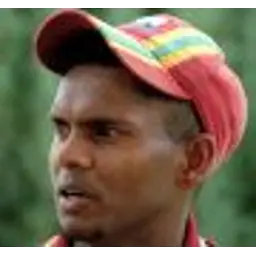
The Reform of Shiv Chanderpaul
reprinted from Trinidad ExpressRealistically by 4.30 p.m., there was no hope for a win in the
final One-Day International between the West Indies and India.
Favourable conditions were already eroded by a rain-affected total,
which left the West Indies to score 248 in 44 overs at 5.63 runs an
over (although the Indians had scored their 260 at 5.2).
Then openers Wavell Hinds and Chris Gayle went cheaply and quickly
before Ramnaresh Sarwan and Brian Lara came together; but they did
little to meet the required run rate, and though they scored some
runs, the rate climbed to seven-plus and stayed there throughout
the innings. Neither batsman opened up the way the near-capacity
crowd kept expecting them to, and by the time they departed,
followed closely by skipper Carl Hooper, the festive air had
slumped into the doldrums. Then came Shiv...
Shivnarine Chanderpaul came, and as he aggressively pursued his
51 runs, a kind of wild optimism gripped the Queen's Park Oval.
They smelled possibility, and they jumped and cheered its tentative
presence as if willing it to harden into reality. As Ridley Jacobs
hammered a boundary at 4.40, it didn?t matter to anyone that there
were still 96 runs to get in 12 and a half overs, with only bowlers
behind. True, a One-Day crowd is a party animal, seeking
entertainment with no hard feelings about the outcome and tenor of
the game; but when Sarwan, Hooper and Lara left, the gloom was
unmistakeable.
But Chanderpaul and Jacobs showed no tentativeness; neither to the
bowling nor to the predicament. They were playing their shots
confidently, running alertly, and brought a spiritedness to the
innings that had not yet been seen. When Chanderpaul made his
fifty, it was to a standing ovation.
If, with 96 runs to go at more than seven an over, we were in deep
trouble, the temperament of the two ignored that, and concentrated
instead on making it so possible, that once again, the Indian team
suddenly seemed to be on the backfoot.
Then Chanderpaul was out at 4.45 and we knew we had lost the game.
It was no surprise that the crowd was so pumped up that the music
blaring from the Trini Posse was Tambu?s defiant ?No, No, We ain?t
going home?.
Chanderpaul had again brought hope to West Indies cricket fans. It
was not unsurprising, as his performance in the Test series against
India was a mature, confident one, that earned him the title of Man
of the Series with 562 runs at 140-plus.
Starting with the 140 at Bourda, and keeping up the momentum with
careful, patient, unhurried centuries throughout the series,
Chanderpaul emerged again as a batsman who has refined the promise
he had shown nearly eight years ago when he was first capped for
the West Indies team.
His composure remains intact, his measured strokeplay gives as few
chances to bowlers, and although during the Tests he did not
unleash many flurries of charges on the boundaries and the
scoreboards, he still collected the runs. And in this One-Day, he
showed some flair with a range of strokes and boundaries,
delighting the crowd, who?d come to characterise him as the stolid
Larry Gomes-type of anchor.
The stolidity is still there, but whereas in the past, he had
seemed to be falling prey to a lack of stamina that saw him getting
past 50 many times without coming to a century, in this
incarnation, he can summon reserves to take him where he wants to
go.
It could not have come at a better time. With the team largely
comprised of young players, it is good that the experienced
Chanderpaul has re-emerged from the nebulous state of unfitness,
which had enveloped him for a while.
Are we seeing the re-making of Chanderpaul?
When he first joined the team for the second Test against England
at Bourda, he was only 19, and he celebrated his debut with 62
runs. He followed it with a 50 at the Queen?s Park Oval, but even
then, his was not a sure place on the side. He was in and out of
the team for following tours of India and New Zealand, and even
left out for the 1995 visit by Australia. This after being the not
out partner on 75 to Brian Lara when he scored his 375 runs in
Antigua in April 1994.
But he was the spot of excitement during the tour of Australia at
the end of 1996. With the team performing badly, Chanderpaul put
down a brilliant 71 off 68 balls, with ten fours, before an equally
brilliant Shane Warne ball spun from way outside the off-stump to
hit the middle and off stumps.
He was soon moving up the order, to land at number three, a
position often reserved for the most aggressive batsman on the
team. It was a position, team manager, Clive Lloyd, felt he was
more than able to handle. Remarking that Chanderpaul had been
recruited to fill the opening spot in One-Days, and had been a good
middle-order batsman, Lloyd said, ?He has proved that he can handle
any situation,? adding that the team needed more of that sort of
Larry Gomes type who could weather any storm.
The supporting role has often gone to Chanderpaul, a measure of his
understated doggedness and quiet reliability. His retreating
personality has often been interpreted as a sign of timidity, but
really for this Leo, it is the external manifestation of a
character more hardened and tenacious than he cares to show. He
seems to be a mix of a reserved, cautious, analytical type, who is
given to supporting roles, and a confident, dedicated performer who
believes in getting the job done without fuss. Clearly, he is not
comfortable with the limelight, and appears to dislike intrusions
on his privacy.
But for all that apparent reserve and quiet, there is obviously a
brain ticking somberly and responsibly in there.
For a time, it had seemed that the fame that had come to this
youngster from the rural part of the East Coast in Guyana, Unity
Village, had swept him off his moorings. There were stories of an
eventful nightlife, once leading to a shooting at the seawall in
Georgetown. And a dissolute air seemed to come over him, his
performance level was wavering, and injury after injury saw him and
out of the West Indies team.
Chanderpaul, it seemed, was washed up.
The teenager who?d made it from the Unity Village team to the East
Coast Police squad, and then the Georgetown Cricket Club in no time
at all, had excited enough cricket watchers to propel him into
relative stardom shortly after his first Red Stripe Cup series. The
next step was at the West Indies youth and senior national levels
and he was so impressive (at 17, he scored 90 against the Leewards
who had Kenny Benjamin, Hamesh Anthony and Vaughn Walsh), that in
two years he was on the West Indies squad. Not even Brian Lara had
made such a quick entry.
The ride may have been too sudden and the distance too far in that
short time, and with no counsel and preparation from the West
Indies Cricket Board for their young charges, it is not surprising
if things became derailed for a while.
But he seems to have settled down now. There seems to be a good
rapport between his captain and himself. Physically, there is a
little more to his small frame, and he seems to have worked hard on
his fitness. It shows in the added stamina, which has taken him to
three centuries in this last Test series. That he thought the
Indian bowling was ?sweet? was as clear as when he encountered them
during their 1997 tour (when he was also Man of the Series). This
time around, maybe he senses his seniority and accepts the
responsibility it brings. Maybe now that he is a husband and
father, he is even more focussed and fearless.
And people sense it.
When he strides out to the pitch and takes guard after completing
his ritual of marking his space with the bails, there is a
purposeful sense of leadership surrounding him. It must bring some
confidence to his young teammates, the way Lloyd might have done in
his day. And perhaps in the fullness of time, Chanderpaul might one
day fill that role for the West Indies.
SOURCE: Trinidad
Express