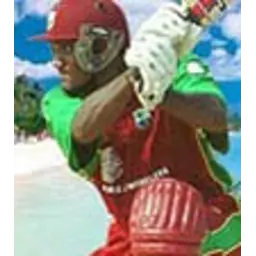
Hooper's Greatest Innings Ever
At the beginning all went more than well with young Hooper. He
soon became one of the great young West Indians - in 1987, for
instance, dominating the regional Youth series as it had never been
dominated before and is unlikely to be dominated again.
When he entered upon his first-class career in the regional
competition he at once scored a century which he himself remembers
with particular delight and which made him a hero in the eyes of
the knowledgeable cricket-lovers at Kensington.
Very soon, as if by royal right, he was called to Test cricket
and in his second match, in India in 1988, in the natural order of
things he scored a century. It all seemed effortless and ordained.
One could sit back and admire and not worry too much any longer
about our middle order batting. In due course he would enter the
kingdom where only the likes of the three W's and Sobers and Lloyd
and Kanhai and Richards reign.
We all know what happened then. His career entered a strange and
bewildering doldrums from which he has struggled to emerge. In his
batting there have been anyn umber of inexplicable failures. It is
not that he has lacked temperament - many times he has played a
crucial role at nerve-tingling times: witness only his acclaimed
134 in the third Test in Pakistan in 1989 and, of course, his role
in the famous tied International at Bourda a few weeks ago. And it
certainly is not that there is any fundamental flaw in his
technique - the technical apparatus of his batting is superb. And
his brilliant talent has been acknowledged even by his most
stubborn detractors.
It has seemed more a matter of carelessness and lack of
concentration. And perhaps there was in it an element of mounting
over-anxiety to please, to make amends to those who kept the faith
in him. He must prove at once, or very early in an innings that he
was the masterly batsman everyone expected him to be. And when he
failed, again, so the next time it was even more important to prove
his talent quickly and dramatically. So do young men overawed by
adulation put pressure on themselves to perform at some supreme,
impossible pitch. He should have grafted more and longer - expect
that genius finds it hard to graft.
The set-backs and the long periods when achievement did not match
the expectional talent (had the promise been less, perhaps the
criticism would have been lower-keyed) led to an increasing stream
of criticism which must have become hard for the young man to bear.
Despite his many achievements and growing contribution to the West
Indian team as a steadily improving slow bowler and peerless slip
catcher, the criticism has focused exclusively on his batting
failures. (And there is merit in that. I think Hooper will end up
taking over 10 Test wickets.
But it is true that one doesn't spend much time describing Mozart's
literary efforts or Derek Walcott's paintings. Carl Hooper is a
batman). Even on those occasions when he has done reasonably well
with the bat the success has been belittled as too little too late.
At times the voices raised against him have become a chorus which
seemed to endanger his place on the team. Even Tony Cozier, most
knowledgeable of cricket commentators, has been strangely perverse
in emphasizing Hooper's failures, down-grading Hooper's successes,
and making the case more often than not why he should be dropped.
For a young man, as I say, it must have been hard to bear.
The anti-Hooper campaign has always seemed to me utterly misguided.
You do not lightly cast aside genius when you are lucky enough to
have discovered it. The selectors must have sensed that. Certainly
Richie Richardson knew it: is it my imagination or has Richardson
over the last few difficult months for Hooper made a point of
putting an arm around the young man's shoulders whenever the
opportunity arises? At least Hooper will have known that his
captain's confidence in him is secure.
Those who have been prepared to drop Hooper should remember the
story of Frank Worrell and the English batsman Tom Graveney. I
think it was in 1963 the West Indies were touring England. Two days
before the first Test the captain Frank Worrell came into the
dressing room where the West Indian team were relaxing after a
work-out. He had a bottle of champagne in his hand and with a smile
he invited the team to join him in a drink. A couple of the boys,
mystified, asked him why the celebration on what was only the eve
of the first Test. With a broad grin Frank Worrell explained: "The
jack-asses! They leave out their best man - Tom Graveney not in the
side!"
So let us come to the occasion when Carl Hooper at last, surely,
put even the most tenacious of doubters to flight. Sadly, we in
Guyana were not able to watch his great innings of 178 not out at
the Antigua Recreation Ground. The failure of the television
transmission was a serious deprivation. But still it was music to
the ears to listen with growing satisfaction as Hooper's innings
unfolded from its first careful and even tentative beginnings to
assured mastery as he gathered confidence to dominating brilliance
as his genius flowered.
How full the heart felt for the young man who has had to endure so
long a travail and bear such a burden, a carping criticism! How
good it was to hear the commentators' unstinted praise and
acknowledgment of an extraordinary talent now finding full
expression: a pull shot worthy of the great Richards, a straight
drive with something of the power of Greenidge and the elegance of
Dujon, a late cut whose original was Frank Worrell's patent, a most
delicate leg glance which one remembered from the repertoire of
Jeffrey Stollmeyer, a square drive which Lawrence Rowe might have
fashioned. All of these great names were invoked. Here at last was
Hooper mentioned in company he deserved.
Of course he impressed his own band of genius on the stroke-making
and the commentators tried their best to measure it. But they found
it hard. It was said of Frank Woolley that in one over there might
be an exquisite off-drive, followed by a perfect cut, then an
effortless leg-glide. In the next over, and the next, the same sort
of thing happened. And soon the superlatives became repetitive. Now
one felt that the commentators were having that sort of trouble
with Hooper. So they called in aid our great men to compare.
After a while, though, my ear became attuned to something heard
through the commentary which I might not have perceived if I had
been viewing the innings on television. I might have missed it in
the excitement of watching. I realized that the descriptions and
the comments were not all there was to hear. There was something
much more, something which put me more subtly, more richly, in
touch with the true spirit of that great innings. In the end, one
did not need the commentary to sense that something special was
unfolding. Before the stroke's description one could hear the gasp
of the crowd, the indrawn breath of sudden, high admiration and the
drawn-out "aaah" of deep satisfaction which are the most heart-felt
tribute any audience ever gives to any artist. They are the best
measure of the triumph of genius. The commentator's, or the
critic's, subsequent praise can only fall short of such spontaneous
tribute.
Not long ago I read a passage in the autobiography of the sculptor
Eric Gill:
"And while I am thus writing about the beauty and impressiveness
of technical prowess I cannot, for it made an immense difference to
my mind, omit the famous name of Ranjitsinhji. Even now, when I
want to have a quiet wallow in the thought of something wholly
delightful and perfect, I think of Ranji on the county ground at
Hove...
There were many minor stars, each with his special and beloved
technique, but nothing on earth could approach the special quality
of Ranji's batting and fielding ..... I only place it on record
that such craftsmanship and grace entered into my very soul."
I never saw Ranjitsinhji but I felt I knew what Eric Gill meant
because I had seen Frank Worrell and I had seen Rohan Kanhai. And
now, I think, the commentators, seeing Hooper's innings, sensed the
feeling too.
When Hooper was well launched and beginning to exult in the freedom
his exceptional gifts at last allowed him, one could sense through
the cadences of the crowd's expressive voice the awe his batting
was generating and the pure delight he was giving. What more could
any sportsman, craftsman, artist desire? He was lifting his
audience along on his wave of glory - you could hear and feel it.
He knows that the feeling is like now for the first time - the
unreserved blessing of a home crowd. He knows what heroes feel
like. I hope he has got the unforgettable taste of it and that he
will yearn to savour more. That is the spur. Forget statistics.
That feeling is fame's true spur. May it drive him on the rest of a
long career which will bless us all and honour the game.
* Ian McDonald is a well-known Caribbean columnist. This column
first appeared in Guyana's Stabroek News.