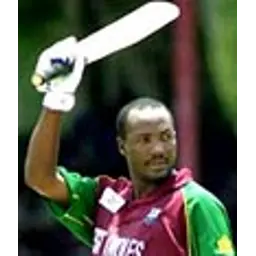
Lots to Celebrate Besides Lara
The opening game of the 2003 World Cup may well go down as the one in which the West Indies turned the proverbial corner. After making a very tentative start, and being a mere 67/2 at the 25 over mark, Lara and Chanderpaul repaired the damage, only for Hooper, Powell and Sarwan to accelerate in scintillating fashion. The disciplined South African attack, backed up by very sharp fielding, was taken for 212 runs in the remaining 25 overs.
After a shaky start, including a much talked about chance, which was really too difficult to be really described as such, Lara opened out and played shot after shot which reinforced his position as one of the game's great batsmen. The trademark flourish with which he played and the incredible bat speed he generated saw the ball speed to the fence even when fieldsmen were placed on the fence in those exact positions. The standing ovation he got from a crowd packed with South African supporters told a tale about their sportsmanship as much as it did about the quality of his batting.
Lara may well be the toast of the West Indies today, but the reasons for celebration lie far deeper. For one thing, even this performance by the West Indian team was not a reflection of its full batting potential. Both Gayle and Hinds seemed to be rather overawed by the occasion, and allowed the South African bowlers to bowl maiden after maiden.
The lack of strictness in umpire Venkat's interpretation of the wide rule to deliveries outside the offstump only added to the early West Indian woes. The West Indian batting can be truly destructive when Gayle and Hinds, both superb strokemakers, get the team off to a good start.
However, the younger batsmen Powell and Sarwan played with such incredible confidence and panache that one really wondered if this was a West Indian team from an earlier era. An era in which Caribbean batsmanship was renowned the world over for its ability to build platforms from which the fast bowlers could dominate. From being a team which routinely lost half its wickets before a hundred runs were on the board, this team suddenly cannot seem to accomodate Marlon Samuels, who scored brilliant centuries in India in both tests and one-day games.
Sarwan seems to have come into his own after the series in India, where he and the other West Indian batsmen were called on to consistently put large totals on the board. And Ricardo Powell, forever in and out of the team, now seems to be a vital component at the bottom of the batting order.
While the batting seems in fine fettle, the bowling and fielding could do with some improvement. Pedro Collins does bowl some wicket-taking deliveries, and can get the ball to swing around disconcertingly in conditions that suit him. It may be too early, however, to treat him as a fixture in the ODI side.
Just as the presence of Marlon Samuels on the sidelines is an incentive for Powell and possibly Sarwan to excel, it would be in the interest of the team to see that Collins knows that McLean and Lawson are competitors for his spot. A team with seven specialist batsmen and Jacobs may not need further batsmen, but McLean can score runs late in the order, and is a wicket-taking bowler much like Collins.
Lawson is still raw, but his extra yard of pace can help take wickets when the West Indies bowling has a large target to back it up. The other important fact is that neither Lawson nor McLean are likely to be as much of a liability in the field as Collins; it will be a long time before West Indian supporters forget the languid backward steps that Collins took to finally land on the boundary rope after taking that catch off Klusener.
If is not too obvious to mention, the reality of today's one-day cricket is that any team should expect to fight hard for runs in the field even if it is defending a total of 300. Even if the West Indian batting continues in the same sublime vein, the bowling and fielding are going to be tested to the limit before this tournament is over.
In all the euphoria of the victory against South Africa, let us not forget that two brilliant pieces of cricket in the field ultimately won us the game. First, with 13 needed off 10 deliveries, Klusener hit a cover drive that rocketed towards the cover fence. In an incredible piece of fielding, Chanderpaul dived and pulled back what looked like a certain boundary.
Secondly, in the last over of the game, Drakes seemed to put his foot down and insist that he wanted a fielder on the midwicket fence. Hooper moved himself there, and took the catch off Klusener off the very next ball.
Either due to bad fielding, or bad field placement, had either of those deliveries reached the boundary, today's West Indian celebrations would have been replaced by the usual post-defeat analyses.
All things said, however, this victory against South Africa is a huge shot in the arm. Premature though it may be, one is tempted to compare this victory to the one in the 1975 World Cup, when Murray and Roberts put together an incredible last wicket partnership to beat Pakistan in a game which was all but lost. As Lloyd described it, the mood after that game was "there's no way we are not going to win the title after a victory like that".
Regardless of whether this West Indian team sees this victory in a similar light, the days of West Indian gloom over inept batting seem to be a thing of the past.