
'Reds' Perreira Unplugged
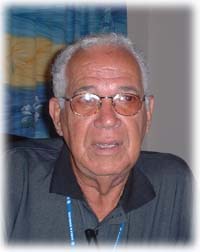
For more than three decades, the voice of Joseph 'Reds' Perreira has been a staple on the West Indies airwaves, calling cricket games from every corner of the world. His voice represents the passion shared by all Caribbean fans, whether the team is winning or losing.
On the Test match scene, 'Reds' has seen it all. And all through the years, he has represented the Caribbean well with a microphone in his hand without having to be a biased commentator. In this interview with CaribbeanCricket.com roving correspondent Michelle McDonald, 'Reds' reminisces about the old days and the problems facing cricket in the region...

Q: You have been involved in West Indies cricket for a long time as a journalist and so you have a very good view, you?re looking at a lot of matches and a lot of players. First of all, how long have you been a commentator?
My first test match was in 1971. My first First Class match was in 1959/60 when British Guiana was still British Guiana, and British Guiana played Trinidad and Tobago at the Rose Hall in Berbice.
How did you get involved in commentary?
I had a mother that encouraged fantasy and I stammered very badly as a child. When I used to lie in bed, - and I was a great listener of cricket, I listened to the 1950 West Indies vs England, I listened to 1951 when the West Indies went to Australia, - I would do imaginary commentary. ?Alec Bedser bowling to Worrell, and Truman bowling to Kanhai and Laker bowling to Sobers?, and describing the field. Never stammered when commentating. So my mother encouraged fantasy because I was using words, I was talking.
I was really a bad stammerer and I simply kidded around and everybody at parties would say ?come on, let?s have some commentary?. So I got an old tape recorder and I started to do some stuff in trial matches and the word got around and the Rediffusion station called me and asked me if I wanted to do an audition.
I did the audition and I did my first game in British Guiana. The reason why I got in was because Jamaica was playing Barbados and British Guiana was playing Trinidad on the same weekend in British Guiana and of course, the quality match was Jamaica vs Barbados with Roy Gilchrist versus the strong Barbadian batting of the late Conrad Hunte and Cammie Smith and Sobers and Nurse. That?s how I got in. There were two matches so they had to find two commentary panels.
After that first stint, what happened next?
I went to England in the spring of my youth to learn about the world and I didn?t do any commentary for a very long time but I watched a lot of cricket in England and I worked for BBC World Service as a freelancer.
In those days, to do an interview with any sporting personalities, you got 5 guineas and 5 guineas was a lot of money in those days. But my whole period in England was watching cricket and doing pre-season training sessions with Chelsea, and with Arsenal in particular, because I was interested in sports in general.
I did a pre-season under Dave Sexton at Chelsea and funny enough, Dave Sexton also was at Arsenal ? they had a set of different managers. I remember that the Arsenal manager was Bertie Mee at that time, and you?d go up to Stanford Bridge, you?d go up to Arsenal, and be able to look at the coaching aspect of it which led me to coach football in Guyana, I was appointed to coach the Guyana U-23 football team, and later I coached a team called Santos, which later came from an intermediate team to be one of the leading football team in Guyana.
But cricket was really the first love?
Yes, cricket was the first love as was cricket the first love of any West Indian boy growing up in that era. I?m not too sure you could say cricket is the first love now.
What do you remember from that first Test match you did in 1971?
The match was India versus the West Indies. The great team of Gavaskar, along with greats like Bedi, Venkat and Sardesi. I worked with a great Indian commentator called Berry Sarbadikary. He had had tremendous problems leaving India and arrived in Jamaica very sick and he was sick throughout the remainder of the tour.
I remember having to bring tea in a flask so he could have tea and keep his strength up during the game. But a wonderful man who probably still is the most well known Indian commentator especially in the early days of English radio broadcasting in India.
Is there any particular match or any particular series that stands out in your mind?
Well, that?s very difficult. The first time we beat Australia in Australia had to be a very special series ? 1979 under Clive Lloyd. The West Indies had drawn in Brisbane and Clive Lloyd didn?t play. Deryck Murray captained the side because Clive Lloyd had a bad knee, and then the West Indies, with Lloyd back, beat Australia at the MCG in Melbourne, and then beat Australia at the Adelaide Oval in South Australia and the West Indies had won the series 2?0. That?s something to remember.
Again in Jamaica when the 4th day was washed out, the match looked like a draw and the West Indies managed to bowl out India and Viv Richards, Gordon Greenidge and Haynes put together a pretty good partnership. Richards lead an onslaught on the Indian bowling and out of the storybook of life, the West Indies was able to snatch victory at Sabina Park.
The World Cup of 1975 when myself and Tony Cozier did the final with Brian Johnson and John Arlott is another fond memory. Freddy Truman and Trevor Bailey were the comments men. In that World Cup we were on the verge of being knocked out by Pakistan. They had made about 276 I think, and the West Indies were 203 for 9. We had maybe taken the runs too lightly and the next thing we were in trouble.
Roberts walked out to join Murray and this game turned out to be the most nail-biting event. 210, 215 for 9, 220 for 9, 220 for 9, and it went on and on. I was doing the last commentary shift and was supposed to hand over either to Tony Cozier or to Jeff Charles, I think it was Jeff Charles who was the next commentator and he said ?No, stay. Finish it?.
The atmosphere was very tense. I was told later by Clyde Walcott in the West Indies dressing room ? he was Manager ? that nobody was moving. Anybody who sat in the chair did not want to bring bad luck by moving and when that final run came, I think Murray got the final run, I think there were tears in all of our eyes. That was very tense. West Indies went on to win that World Cup, but we came very close to being knocked out.
There was also the game at Adelaide where McDermott was caught Murray bowled Walsh. West Indies won by 1 run. That was also very tense. Those are some that really stick in my mind.
You?ve seen international cricket as a commentator for the last 32 years. You?ve seen West Indies play over that period and now the question is whether the commitment of the current team is as it was in days gone by. How would you respond to that?
Well, life has changed for Caribbean people and the way how the generation behaved in the 60?s, in all walks of life, the way how the generation behaved in the 70?s, 80?s, is totally different from now with all the hi-tech stuff that?s going on; all the communication implements that are around.
In the 60?s and 70?s, and even before that in the 50?s, we produced some marvellous cricketers and I?m very happy that I came along as a commentator in the glory days because it must be very hard on a commentator to come at a time when the side is not winning.
I was part of that, Tony Cozier was also, Roy Lawrence of Jamaica would have had some glory days too, but I was very happy that I came along at the right time so to speak, before the drought set in. The drought set in about 1995. I think what basically might have gone wrong, and there?s no one reason, I think from an administration point of view, from a planning view, the world moved ahead in certain areas, certainly Australia, certainly South Africa, even New Zealand, the planning, the coaching structure the establishment of the academy and the coaching structure at the school level where everybody is singing out of the same hymn book, they got that well nailed down, where we didn?t.
We are now trying to put those things down. Of course, one should also say that everything is relevant to money and for a long time when we dominated the cricketing world, the West Indies didn?t benefit from television rights, and simply benefited from the contractual arrangements from gate receipts.
When we started to actually get money, when we became a richer board, the great players were starting to leave the game and for a long time we made money with all the great players and of course now you have the ICC rule where everybody gets the same amount of money per test match, so we are going to struggle because we don?t have the multinational companies.
If you look at the Australian budget or you look at the Indian budget, the England budget, we just can?t match those. The reason for our demise is such a complex thing. How is cricket at primary school? Whether co-ed education ? and this is not a macho statement ? whether co-ed education has helped cricket? It probably has had no impact on girls playing netball or girls playing tennis but traditional boys schools are having problems, now that they are co-ed schools.
The budget now has got to be shared and when people went to school in the 50?s and 60?s, I would say eight out of 10 teachers were men. Now men don?t seem to be interested in becoming teachers and teachers are 75% women. I?m sure they?re trying their very best to keep the culture within the school system going, but there is a limitation on knowledge, not that there have not been some very knowledgeable women in cricket -- Donna Symmonds is one example -- but those are some of the realities. Now boys age 16 are driving their fathers? car, parental control has changed, nine out of 10 boys played cricket or football, that?s all changed.
Basketball is very popular, and while we?re not sending players to the NBA we are sending some players to Junior College and getting college scholarships. But the economics of playing cricket against the economics of playing volleyball or basketball is a reality. You see a lot of 6 feet 4 guys playing basketball and volleyball, the economics of it is that it is a very very cheap game, and they don?t have to give 8 hours day, 2 days weekend as you do to one cricket match.
So they can have a lifestyle where they can play a sport and still socialise. You really need a very special kind of young man in this era who wants to give ? he?s got to practise 3 times a week and he?s got to play Saturday and Sunday, and where his friends are off water skiing or doing something on the Net, computers, or engaged in other activities, so it?s not an easy task.
Facilities are another issue. The West Indies Cricket Board is trying to get us to sing out of the same hymn book. 'Clarence the Crab' has been launched, it?s a development tool. It?s going to take some time where what?s happening in one territory is happening in all other territories. Until we can achieve that we are going to keep having the material coming out of the Under-19 system with technical flaws.
I think the countries where the coaching is much more across the board in similarity, they are probably producing a better rounded Under?19 player overall. It?s not that we don?t have tremendous talent coming out of the Under?19. Devon Smith is a good example of talent coming out of the Under-19. I think overall they are sending people, in Australia for example, to the First Class level as a more rounded product of the Under ? 19 system.
Looking forward to the 2007 World Cup in the West Indies, obviously for gate receipts to be what we would want it to be, the West Indies team need to improve on their current standard. Put on an administrator?s hat for me and tell me priorities that you would place, so what things do you think needs to be done now, first, second, third, to ensure that when 2007 comes, the West Indies team is a competitive team that is going to reach the finals.
One of the good things about this present crop of players is that the majority of them are very young. More young players will come along. In fact there is a young fast bowler called Jerome Taylor from Jamaica who is quite a prospect. He really attacks the crease very hard, he has a lovely action, it?s flawless, he can bowl pace, he can bowl long.
So there is in fact a lot of talent around, I?m just mentioning one. I suppose there are two aspects of it in terms of World Cup ? one, what?s happening at the venue level, and two what?s happening at the accommodation level. Not very many territories have got the hotels. Are we going to do it with Bed and Breakfast as we first saw in LA in 1984? The Americans didn?t have all the hotels in Los Angeles. Bed and breakfast played a major role. Can we do it with cruise ships? How are we going to solve the travel arrangements? Are we going to use charters? Right now the airline business in the Caribbean is a day-to-day headline in the news. What?s going to happen with that?
Also, I gather that there will be legislation passed by the various territories to make one entry. You arrive in Jamaica for example and you have entered the Caribbean and that would be for the period of the World Cup. You wouldn?t need to be stamped in each country. As far as the team is concerned, well the ICC has got a 10-year programme so that people?s preparation for 2007 is going to be part of the next ICC programme which will have Test Matches and One Day Internationals.
I don?t think that maybe the selection committee before the Viv Richards committee really focussed on the preparation and development of our World Cup squad as they should have. I?ll give you an example. England went to Zimbabwe as part of their development programme. They played only One Day matches. We didn?t have that. So England were able to use a lot of players and come up with a side best suited to competing in the World Cup.
I think this selection committee will have to work within the constraints of the next ICC schedule, but they should make every effort to develop a One Day team by competing in as many One Day competitions as possible, not the back end of a test series where you play 5 or you play seven, but you do a focus as we get to 2005 and 2006 in terms of running some One Day competitions.
That is not as easy as it sounds because of the ICC test match championships.