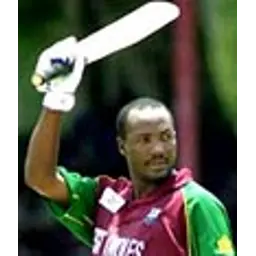
'I didn't short-change anyone'
by JOHN STERN
(Editor, The Wisden Cricketer)
Meeting Brian Lara is a confusing experience. He is charming and suspicious, almost paranoid, in equal measure. He is remarkably articulate and eminently plausible in everything he says. But his is only one side of the story. Much of what he says is self-justifying and when it comes to the big issues he is strong on rhetoric and light on detail.
Brian Lara returns from the hotel bar with a white wine and a mineral water. The wine is his. It's three in the afternoon. "I've retired," he says with a twinkly smile. The following day West Indies will be playing at Lord’s. Lara will be there but in a suit rather than whites. The ground will be sold out but how many bought tickets hoping to see Lara’s last Test at Lord’s? There is an air of disappointment, one that Lara clearly shares. He expected and hoped to be playing at Lord’s but claims he left West Indies cricket on his own terms when he retired so suddenly from the World Cup. It is hard to believe.
“We needed a new direction, someone who was willing to see some sort of change,” he says. “I was willing to do that. I wanted to come to England but I had also said I wanted to finish with one-dayers. It’s not ideal but then how many things in life are?”
 Once we get going, he is chatty. Polished, guarded and measured but chatty none the less. Every now and again he comes out with a word you don’t expect to hear from sportsmen use. “Vicariously” and “reciprocity” flash into the conversation out of nowhere like his lightning cover drives.
 He uses the latter of those words when talking about his friends in cricket. He mentions that he is hoping to meet Shane Warne that evening. When pressed on who his friends are in the game or either in or out of the Caribbean, he says: “I have a lot of people I respect and a lot of people I have time for – reciprocity isn’t necessary.”
Asked about the favourite moments from his glorious career, he very deliberately plays down the batting feats and picks out team achievements, specifically the world-record chase of 418 against Australia in Antigua in 2002-03 and the unlikely Champions Trophy victory at The Oval in 2004. When I bring up his astonishing reflex catch in that game to dismiss Andrew Flintoff he pretends almost not to remember it. “It’s the game, not the catch,” he laughs trying to reinforce the point that contrary to widely-held opinion he IS a team man and not an egotist obsessed with batting records.
No one questions Lara’s ability as a batsman. Indeed, at the risk of alienating a billion Indians, I would give my last tenner to watch him bat rather than Sachin Tendulkar or anyone else from the last decade. It is the sense of uncertainty with Lara, the whole ‘flawed genius’ cliché. Lara is essentially more human and more individual than Tendulkar. Both share similarly unreasonable burdens of expectation but Tendulkar is perhaps fortunate that he has had other stars around him. Lara has been carrying the West Indies team for the best part of a decade. He has had three spells as captain, almost by default as the best player not because he is especially well-equipped to do the job.
The impression he gives is of fighting a losing battle. “It’s a cliché that cricket is the only unifying force in the Caribbean,” he says. “It IS but there are a lot of other factors that keep us apart. Success in sport and war will always unite but you need to have a greater foundation and greater core. That has been tested through the decline of West Indies cricket and we’ve seen how divided we are as a people. Why do I need a passport to go to Jamaica or Barbados?”
Lara insists that West Indies’ problems run very deep. “Cricket has been diluted by the fact there are other options for kids now but that’s a good thing,” he says. “That’s not where the problem lies. It’s that we don’t have a good infrastructure for young guys to develop. West Indies have a great under-15 side. I know a 16-year-old guy in Trinidad who’s awesome but I worry for him because of the facilities. A mediocre Australian cricketer at 17 or 18 will be slapping everyone all over the world five years later. If you don’t have facilities and you don’t have employment then you have a negative atmosphere.”
Clive Lloyd said in last month’s TWC that the current West Indies players “don’t appreciate the importance of what they represent”. Much more aggressive interpretations of this sentiment have been spouted by all manner of former West Indies greats in recent times. When I put Lloyd’s comment to Lara, I expect him to be dismissive. But he warms to the theme: “If you provide it [the history] then the guys will catch on to it. It’s fine to say you’ve got to understand this or read this. This stuff should be taught at youth level so the history of West Indies cricket is embedded in them. Drum it into them so they have no choice.”
Lloyd is probably referring to Caribbean history and culture as a whole rather than just cricket. It is a generational thing. As time passes and the Caribbean leaves its colonial past further behind, the question of nationality and ‘what you represent’ becomes less clearly defined. Britain, on the other side of the post-colonial fence, is grappling with similar issues.
Entertainment is high on the Lara list of priorities.” It’s important for all today’s sportsmen to realise that the guy who’s paying to come through the turnstile is the guy who should mean a lot to you – those are the people who need to be entertained. It’s great to win for your country and be competitive but at the end of the day you want people to leave happy.”
To win or to entertain is the dichotomy of the professional sportsman. A few manage both, plenty manage neither. Lara has entertained, of that there is no doubt, though his unbeaten 400 in Antigua seemed less like vintage showcase than a self-serving attempt to prove a point after a poor series.
Lara proudly says “I’ve done things my way” which can cover a multitude of perceived sins, whether it be selfish batting, eccentric tactics or uninspiring leadership.
“If a man wants to fault me then fine but respect me for trying and that I didn’t short-change anyone. It [the criticism] doesn’t rest heavy with me. People get so caught up in it, they have their own issues. I am less burdened by it.”
Does he feel fulfilled? “I’ve done what I could do so I’m happy with me. As a team, we’ve not been able to climb out of the doldrums so that will remain on my mind. That does not rest well with me. I leave West Indies cricket with my head held high. I’ve tried my best and I’ve worked my arse off. Maybe I could have done things differently but I’ve done things my way – that’s the most important thing.”
So what does Brian Lara do next? He talks confidently and enthusiastically, if vaguely, about projects in Trinidad to build recreational facilities for disadvantaged communities. “My focus now is on the majority, not the elite,” he says persuasively.
He’s not planning a media career even though he talks better than most commentators and pundits. He probably knows he’d end up criticising people and he almost certainly has opinions worth sharing. It’s just that he’s too canny to put himself in a compromising position. His future plans sound impressively worthy but it’s hard to see how that will occupy him for long.
At the start of the interview he said he was “finished” with cricket. Is that really true? He smiles. “I think I am going to play cricket again. If I go six or eight months without cricket I would lose it and I don’t want to lose it yet.”
When I probe him about who he might play for, he avoids eye contact, smiles thinly and looks over my shoulder into the bar where his agents and lawyer are having a meeting. Lashings? “No, no,” he laughs. County cricket? The new Indian breakaway 20-over league? He’s not saying, quite enjoying keeping the suspense, I suspect.
* Republished with permission from The Wisden Cricketer.