West Indies ‘A’ suffer eight-match whitewash as England Lions expose the gaps
West Indies A's recent home series against England Lions ended in a sobering 8-0 whitewash, with the visitors winning all five unofficial One-Day Internationals and all three T20 matches in St Kitts and Nevis. For the Caribbean side, the defeats exposed persistent shortcomings in batting consistency and bowling discipline.
The ODI series: Batting flashes amid a broader struggle
The five-match ODI series was particularly difficult for West Indies 'A'. England Lions won the opening match by four wickets under the DLS method, followed by a crushing 276-run victory in the second. The third encounter offered some encouragement, but England still chased down 274 with six wickets and more than five overs remaining. The Lions then completed the sweep with 80- and 88-run wins in the final two games.
The most alarming performance came in the second ODI, when England piled up 487 for five before dismissing the hosts for 211. It was a telling demonstration of the gulf between the sides in both batting power and execution. There were, however, individual contributions worth recognizing.
Jyd Goolie emerged as one of the more encouraging performers with the bat. His magnificent 119 in the third ODI, the only century by a Caribbean batter throughout the series, was a standout. He followed that up with 51 in the fourth, taking his series aggregate and average to 247 runs and 49.40, respectively.
Opener Kirk McKenzie also made notable contributions, accumulating 219 runs, including knocks of 67 in the second ODI and 53 in the first, to finish with a series average of 43.8.
Windies No.3 Keacy Carty was another useful contributor, hitting back-to-back half-centuries to begin the series (57 and 75) before scoring 51 in the fourth contest to finish with 216 runs and an average of 43.20.
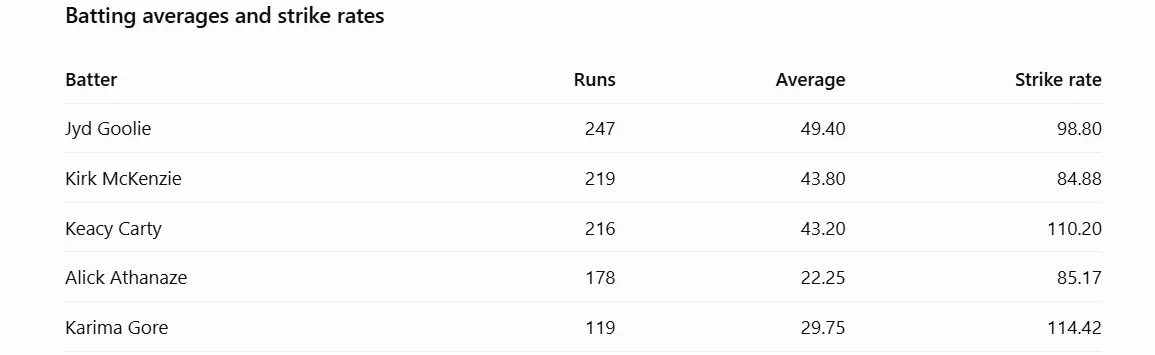
*Goolie's retirement in the second game takes his average to 61.75
While Goolie, Carty and McKenzie provided some encouragement, the overall batting effort was undermined by inexpensive dismissals and an inability to build substantial partnerships.
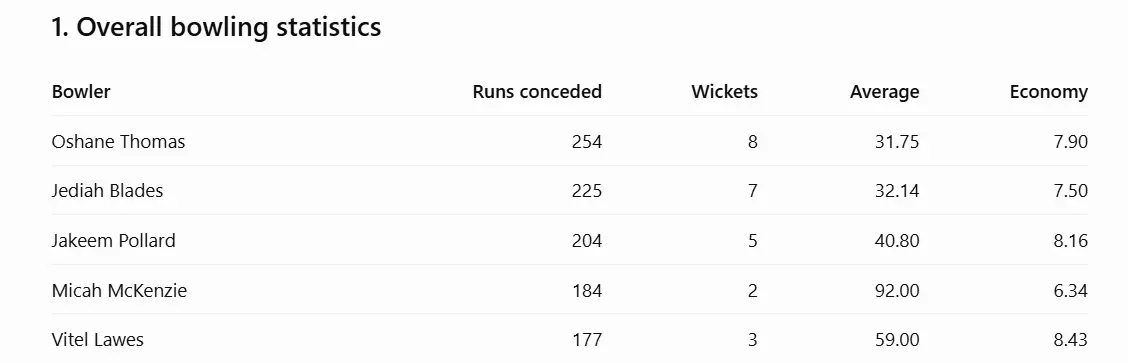
Yet the bowling offered fewer reasons for optimism. West Indies ‘A’ struggled to contain England's aggressive batting, particularly in the second ODI, where the attack conceded 487 runs. Oshane Thomas, Jakeem Pollard, Jediah Blades, and Vitel Lawes showed glimpses of quality, but the collective failure to control scoring rates was a recurring problem.
Thomas finished as the leading West Indian wicket-taker in the ODI contests, with eight in four appearances but at 31.75 apiece. The home side’s attack was unable to consistently restrict England's top order or prevent substantial partnerships.
The T20 series: A more painful examination
If the ODI results exposed the shortcomings in the longer format, the T20 series demonstrated how far the next crop of West Indies players still had to go in matching England's intensity in the shortest.
The visitors won the opening encounter by eight wickets after dismissing West Indies ‘A’ for 98. The second match provided the home side's best batting performance, with 134 for seven in pursuit of 152, but England eventually prevailed by 17 runs. The final game was particularly one-sided, with England scoring 219 for seven before dismissing West Indies ‘A’ for 123, securing a 96-run victory.
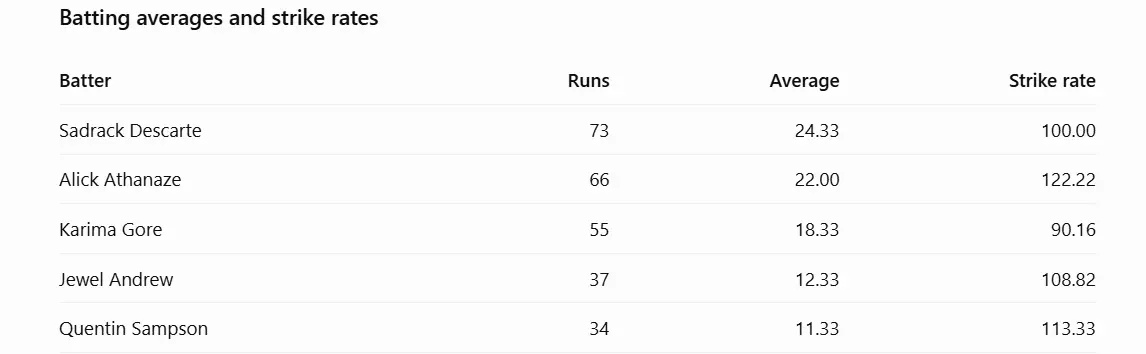
Sadrack Descarte was arguably the most encouraging West Indian batter. His 49 in the second match, which came off 33 deliveries and included four sixes, was a spirited effort. He finished with 73 runs across the three matches.
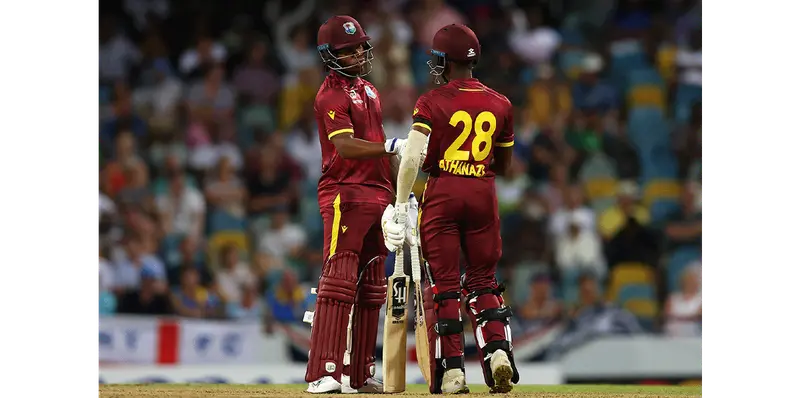
Alick Athanaze scored 66, including 43 in the second encounter, while Karima Gore contributed 55.
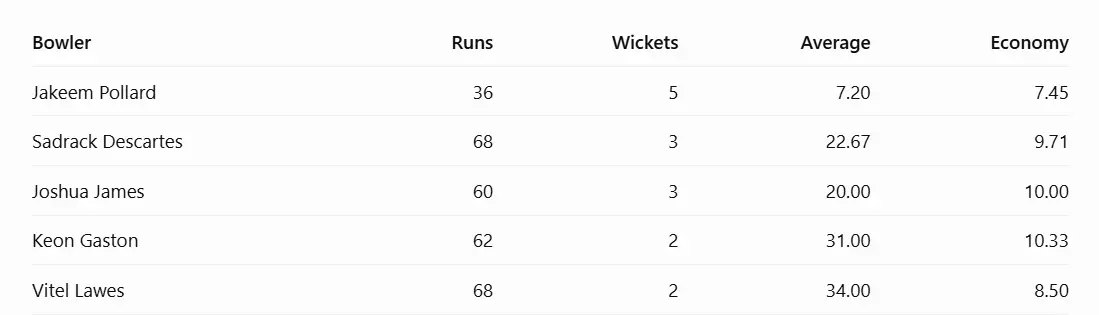
The bowling also had its encouraging spots. Jakeem Pollard claimed five wickets across the three matches, including an impressive four-for-20 in the second T20.
However, England's ability to score freely, particularly in the final match, demonstrated the difference in execution between the teams.