
West Indies' Test batting revival: Cricket West Indies highlights signs of progress
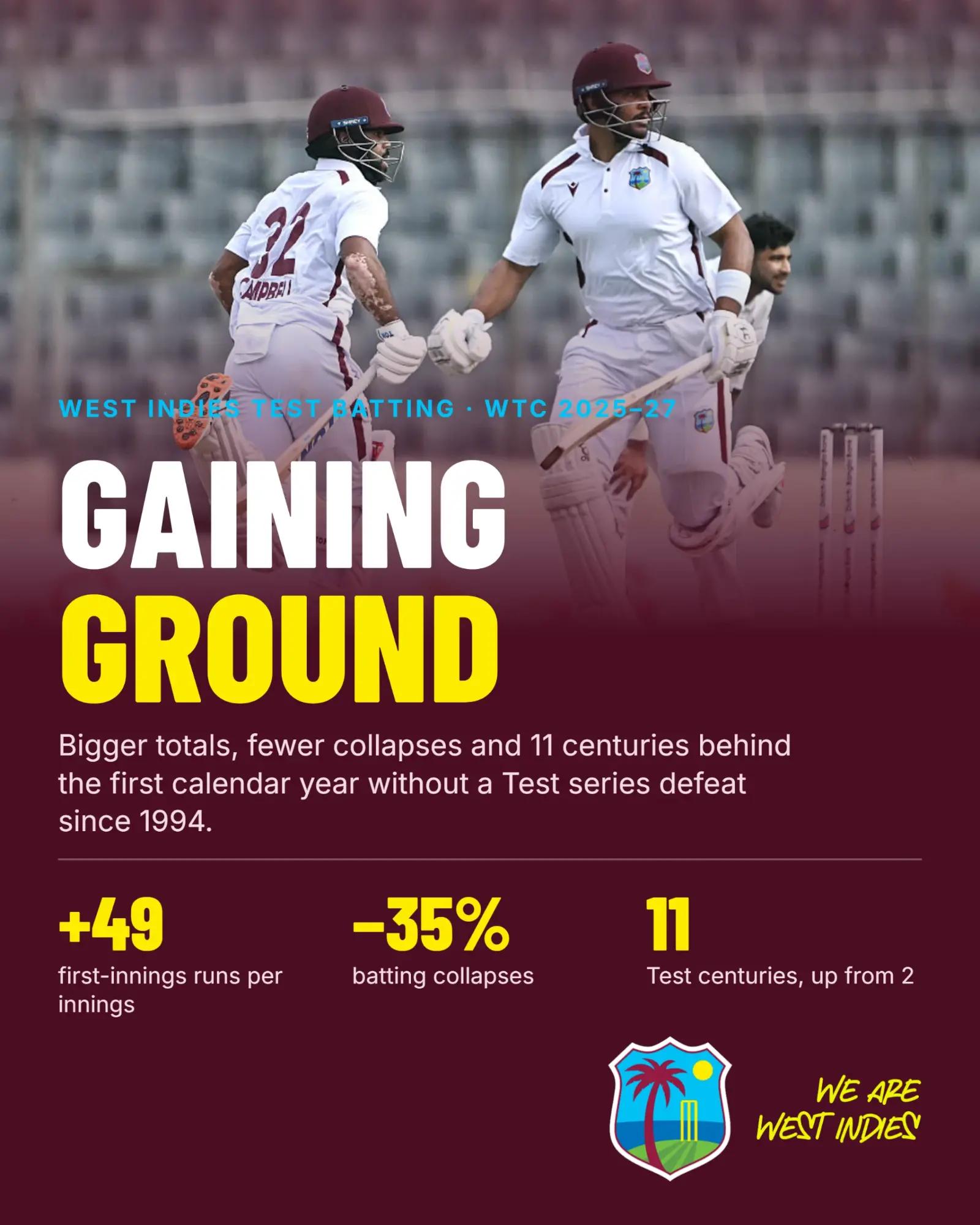
The West Indies have completed their first calendar year without losing a Test series since 1994, and the numbers behind it show a batting line-up that has improved steadily across the 2025–2027 World Test Championship cycle.
The cycle opened with the hardest possible challenges: Australia at home, then India in India and New Zealand in New Zealand. The 2026 Tests brought a series win over Sri Lanka and a drawn series with Pakistan, both at home, and a 1–0 series win in Bangladesh that completed the campaign.
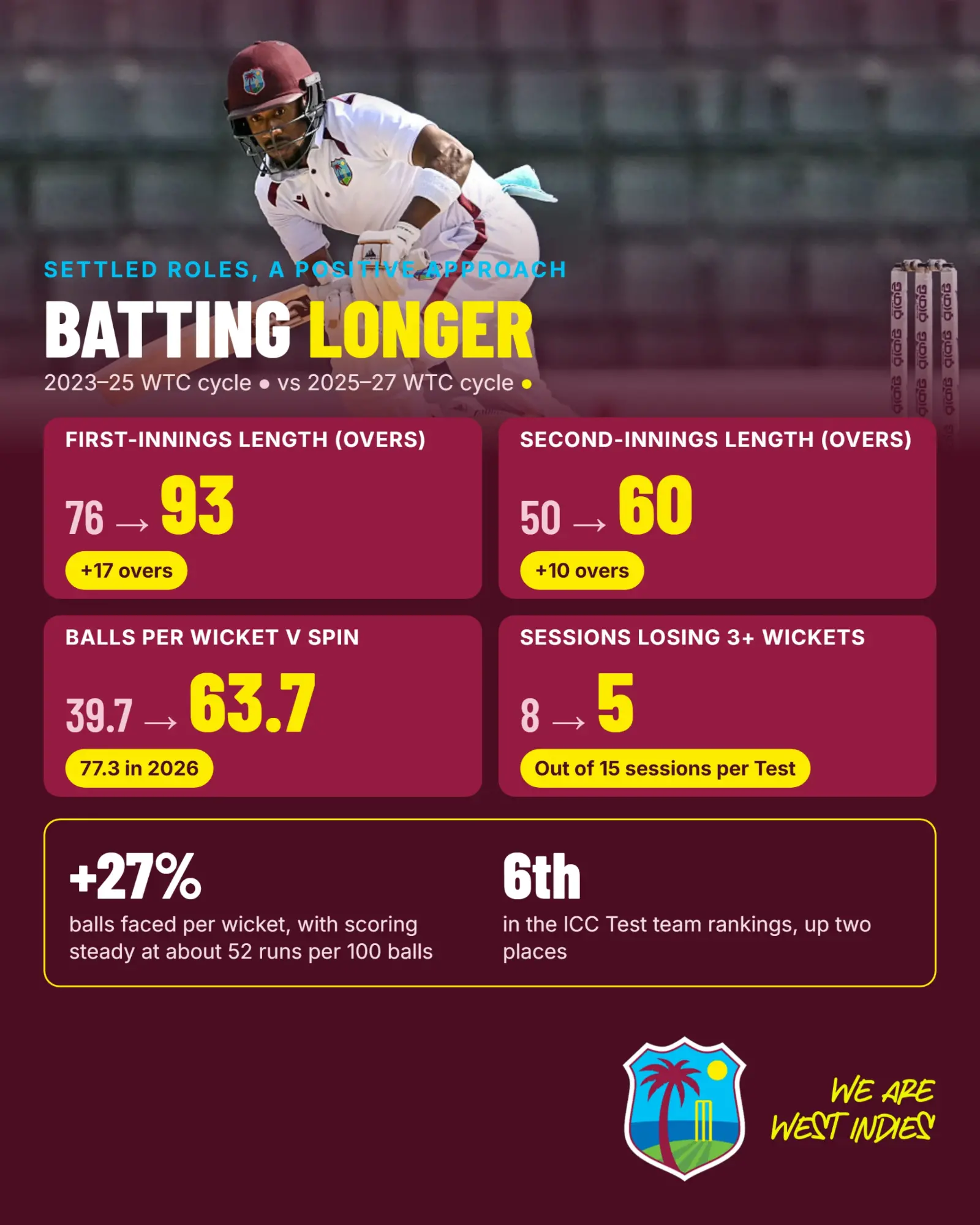
That start is why the West Indies remain eighth of nine in the World Test Championship table, with the improvement showing instead in the ICC Test team rankings, where they have climbed two places to sixth.
In March 2025, before the cycle began, the team’s technical and coaching staff completed an analysis, “Bridging the Gap”, that measured the West Indies against the leading Test sides. It set four batting priorities: raising first- and second-innings totals; cutting out the sessions in which the batting collapsed; improving performance against pace and spin; and strengthening the returns from each position in the order. The top three Test sides were used as benchmarks.
“When this cycle began, we were honest with ourselves about where our Test batting stood,” said Cricket West Indies Director of Cricket, Miles Bascombe. “We set clear, measurable targets, benchmarked against the best sides in the world, and the players and coaching staff have committed to them completely. Bigger totals, fewer collapses and batters turning starts into hundreds tell us the plan is working. The ICC Championship table does not show it yet, and that is the next job.”
Building bigger platforms
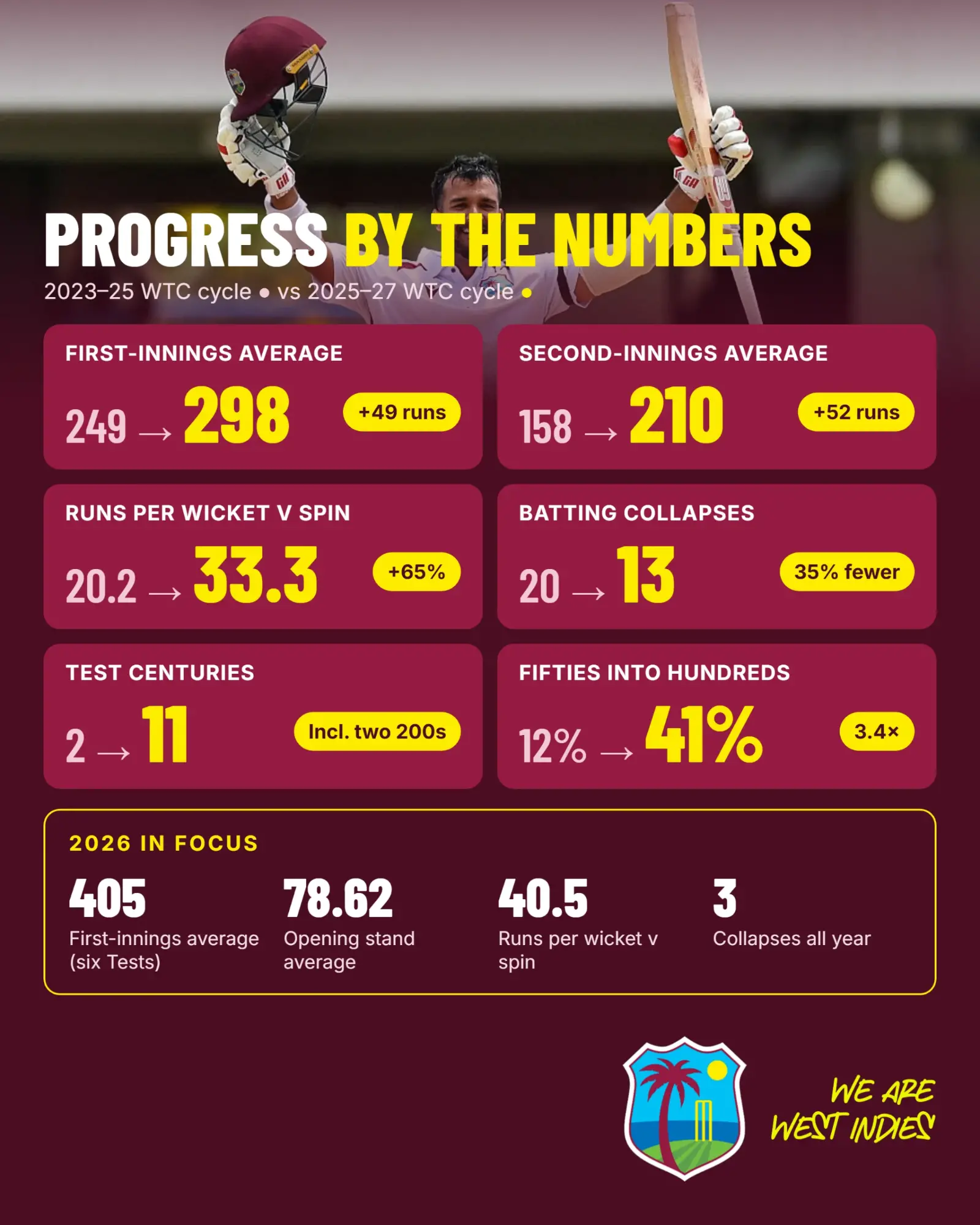
Raising first-innings totals was the priority. Having averaged 249 runs per first innings in the 2023–2025 cycle, the West Indies lifted that to 298 between June 2025 and November 2026, an increase of 49 runs. That clears the 275-benchmark set by each of the top three sides in the previous cycle.
In 2026, across six Tests, the first-innings average rose to 405. At the top of the order, Brandon King and John Campbell averaged 78.62 as an opening pair across nine innings together, with three century stands and three more of 50 or more.
Greater resilience
The gains have carried into the second innings, with the average second-innings total rising from 158 in the previous cycle to 210, two runs short of the 212 to 224 the top three sides averaged. In 2026, the team batted five times in the second innings and was only bowled out twice.
Collapses, defined as the loss of three wickets for fewer than 30 runs, have fallen from 20 in the 2023–2025 cycle to 13 across a comparable number of Tests in 2025 – 2027, a reduction of 35 per cent, with three in 2026. On average, the side now loses three or more wickets in five of a Test’s 15 sessions, down from eight. The leading sides manage closer to one, and that remains the target.
Stronger against spin
The biggest technical gain has come against spin, the weakness the March 2025 analysis identified most clearly. West Indies batters averaged 20.2 runs per wicket against slow bowling in the 2023–2025 cycle. That has risen to 33.3 in this cycle, an improvement of 65 per cent, and to 40.5 in 2026. Balls faced per wicket against spin rose from 39.7 to 63.7, and to 77.3 in 2026. Australia averaged 43.8 against spin over the same benchmark period: the West Indies are closer, not yet level.
Batting Coach Floyd Reifer says there were technical and mentality changes from the batting group.
“What we did when we analysed the data ahead of the cycle was break down our players’ skills and techniques, identify areas that needed improvement, and make the necessary adjustments to their alignment and skill sets. We placed significant emphasis on this through a cultural shift, changing the way we practised and establishing a different work ethic. The players were also willing to adapt their skill sets and mindsets.” Reifer said. “Technical adjustments, greater attention to detail, and the development of individualised programmes were key elements of our approach. We shared these programmes with the franchises, supported by follow-up videos, calls and conversations, all of which contributed to improving our batting output.”
Speaking specifically on the improvement against spin, Reifer said: “Batting against spin has been our Achilles’ heel for several years, and I could confidently say that this is one of the best West Indies batting units against spin bowling that we have seen in a long time. The players bought into the plans and committed themselves to spending two to two and a half hours batting in each session, often in the intense heat at our camp in Chennai, to develop and enhance their skills against spin bowling. That commitment ultimately bore fruit as we headed into the final series of the year against Bangladesh.”
Converting starts into hundreds
Batters are turning starts into match-defining innings. There have been 11 centuries across 14 Tests this cycle, including two double centuries, against two in the whole 2023–2025 cycle. The share of fifties converted into hundreds has risen from 12 per cent to 41 per cent. Amir Jangoo embodied by turning his two fifty-plus scores into a double century against Sri Lanka in Antigua and a match-defining 133 against Bangladesh helping the team recover from 27 for 3 to post a competitive 356.
Settled roles, a positive approach
With roles settled, the approach within them has changed: an intent to score, a positive mindset, keeping bowlers under pressure, and being selective about which balls to attack. Batters are staying in far longer without slowing down. First innings now last 93 overs on average, up from 76, and second innings 60, up from 50, often forcing a second new ball. Balls faced per wicket have risen by 27 per cent while the scoring rate has held at about 52 runs per 100 balls, rising to about 55 in 2026.
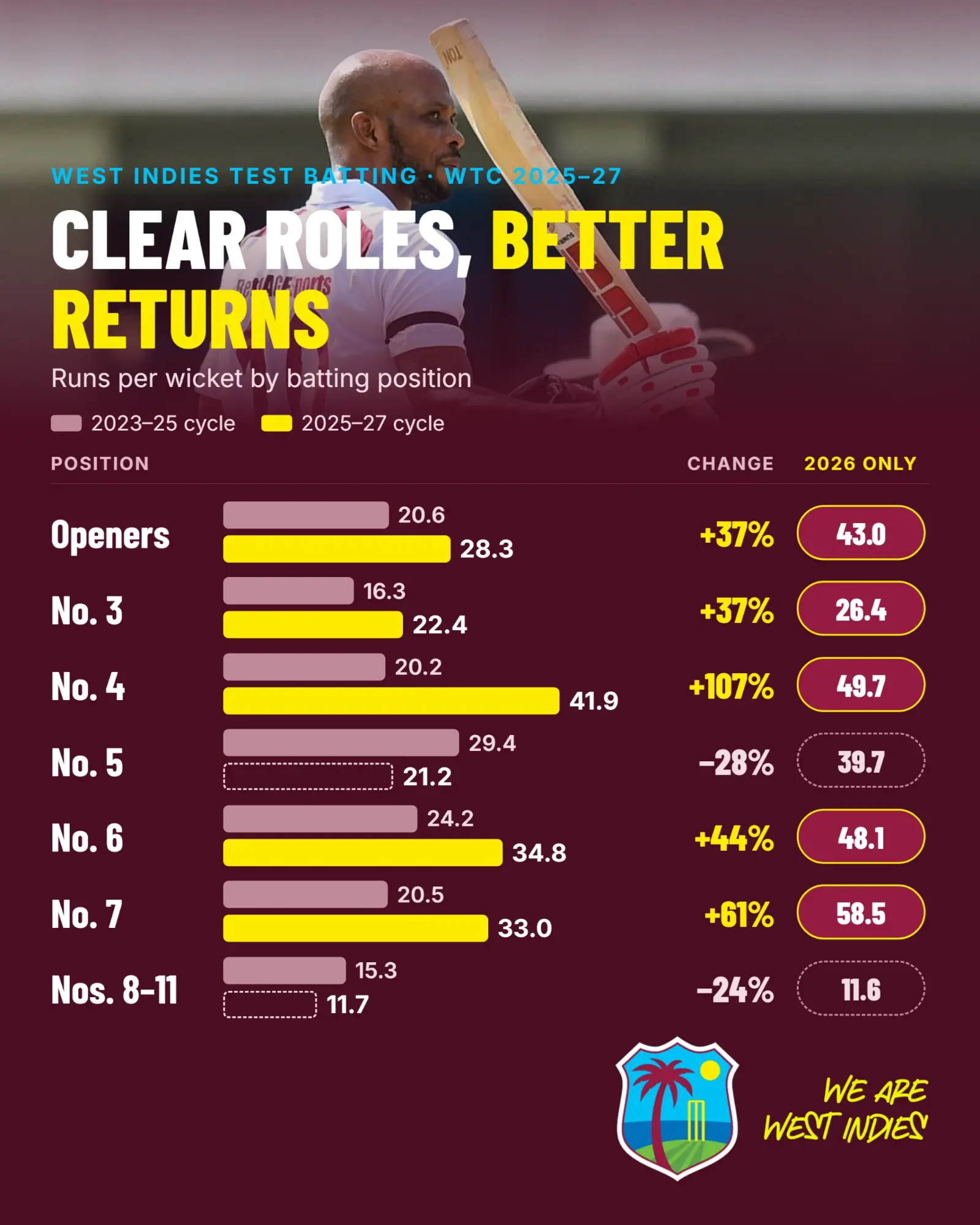
The returns show through the top seven. The openers’ average rose from 20.6 runs per wicket in the previous cycle to 28.3 in this one, reaching 43 in 2026. At number three, it rose from 16.3 to 22.4, and to 26.4 in 2026. Number four showed the biggest gain, from 20.2 to 41.9, and 49.7 in 2026. Number five dipped across the cycle while the role was being settled; once a specialist batter took the position, it averaged 39.7 in 2026. Number six increased from 24.2 to 34.8, and number seven from 20.5 to 33, reaching 48.1 and 58.5 in 2026. The lower order has contributed less than in the previous cycle and is the next area of targeted improvement.
Giving the bowlers more to work with
The batting was the part of the game that most needed to improve. The bowling has been the side’s constant. With the new ball, the attack now concedes 3.42 runs an over, down from 4.35 and level with Australia, and dot balls have risen from 68.5 to 75.7 per cent. More than half the pace bowlers’ deliveries and about two in three from the spinners now land in the good areas. Much of the batting improvement is about catching up with the standard the bowlers have set, and bigger totals matter most for what they give the attack: time to bowl sides out and runs to bowl at.
Taken together, the figures show the priorities set at the start of the cycle turning into results, with the gaps that remain clearly in view.
“These are encouraging foundations. The challenge now is to sustain this consistency and turn it into more Test wins,” Bascombe said. “Our aim in the next World Test Championship cycle is to challenge for a top five finish. Our bowlers have set a high standard throughout this cycle, and the batting is now giving them the platforms to win more Test matches.”
CWI